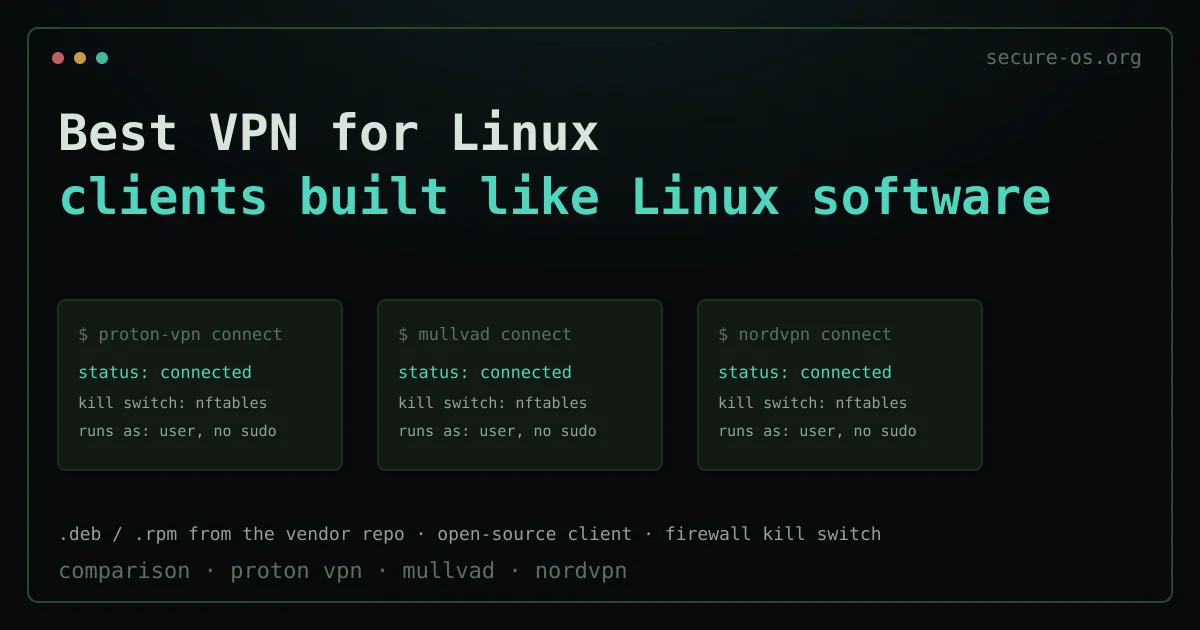
Oct 17, 2026 in vpn, linux, privacy - The best VPN for Linux is the one whose client ships as a real package, keeps a kill switch that survives suspend, and runs without root. Proton VPN, Mullvad and NordVPN compared on Ubuntu, Mint, Fedora, Debian and Arch, with the free option and the one that needs no email.
Oct 16, 2026 in tails, boot, troubleshooting - Tails passes the boot loader and then stops on a blue background, a black screen or an error, with no Welcome Screen. What that usually means, the graphics card workarounds documented by Tails, how to add a boot option in GRUB or SYSLINUX, and what to send to Tails support if nothing works.
Oct 13, 2026 in grapheneos, pixel, android - The 21 devices GrapheneOS officially supports, the 13 it recommends buying, and the end-of-support date for each, read on grapheneos.org on 13 October 2026. Plus why Samsung, Xiaomi, OnePlus and Motorola phones are not on the list.
Oct 7, 2026 in ubuntu, updates, hardening - The stock 50unattended-upgrades file installs security updates every day, but never reboots, never emails, and ignores third-party repositories. A line-by-line reading of the shipped defaults, with the override file to fix each gap.
Sep 20, 2026 in linux, privacy, distros - The best Linux distro for privacy depends on what you need to hide and from whom. Six distros compared by what data they collect, what they route through Tor, and what they leave on disk.
Sep 6, 2026 in privacy, photos, metadata - Every photo your phone takes carries a hidden block of data, and on a photo taken at home that block can include the coordinates of your front door. Here is how to see what is in yours, strip it on each platform, and which sharing apps remove it for you already.
Sep 6, 2026 in phone, scams, privacy - Blocking numbers one by one cannot keep up with software that changes number every call. What actually reduces the volume is carrier filtering, a setting already on your phone, and one habit that costs nothing. Also: why answering at all makes it worse.
Sep 6, 2026 in tracking, phone, privacy - An AirTag that is not with its owner will try to alert you, but only once several conditions line up. Here is what the alert actually says, why Android detection works differently, how to make a tracker reveal itself on purpose, and what to do once you have found one.
Sep 6, 2026 in headers, web security, csp - Six response headers are the ones every hardening guide lists. We measured them on 336 public organisations: 78 of the 301 that answered send none of the six, and Permissions-Policy is missing on eight sites out of ten. The list, in the order worth deploying it.
Sep 6, 2026 in ssh, authentication, linux - The message says publickey, so people regenerate keys. That is almost never the problem. In descending order of frequency: the wrong key was offered, the file permissions are too open, the username is wrong, or the server does not allow that method. How to find out in one command.
Sep 6, 2026 in phone, theft, accounts - Locating it is not the first thing to do, and it is rarely the useful one. What matters in the first hour is the accounts the phone was signed into and the SIM that receives your codes. The order that limits the damage, and the two steps to take before it ever happens.
Sep 6, 2026 in windows 11, copilot, privacy - Hiding the button, disabling the feature by policy, and uninstalling the package are three different things with three different outcomes. Which one survives an update, which one needs Pro, and the honest answer about what still runs afterwards.